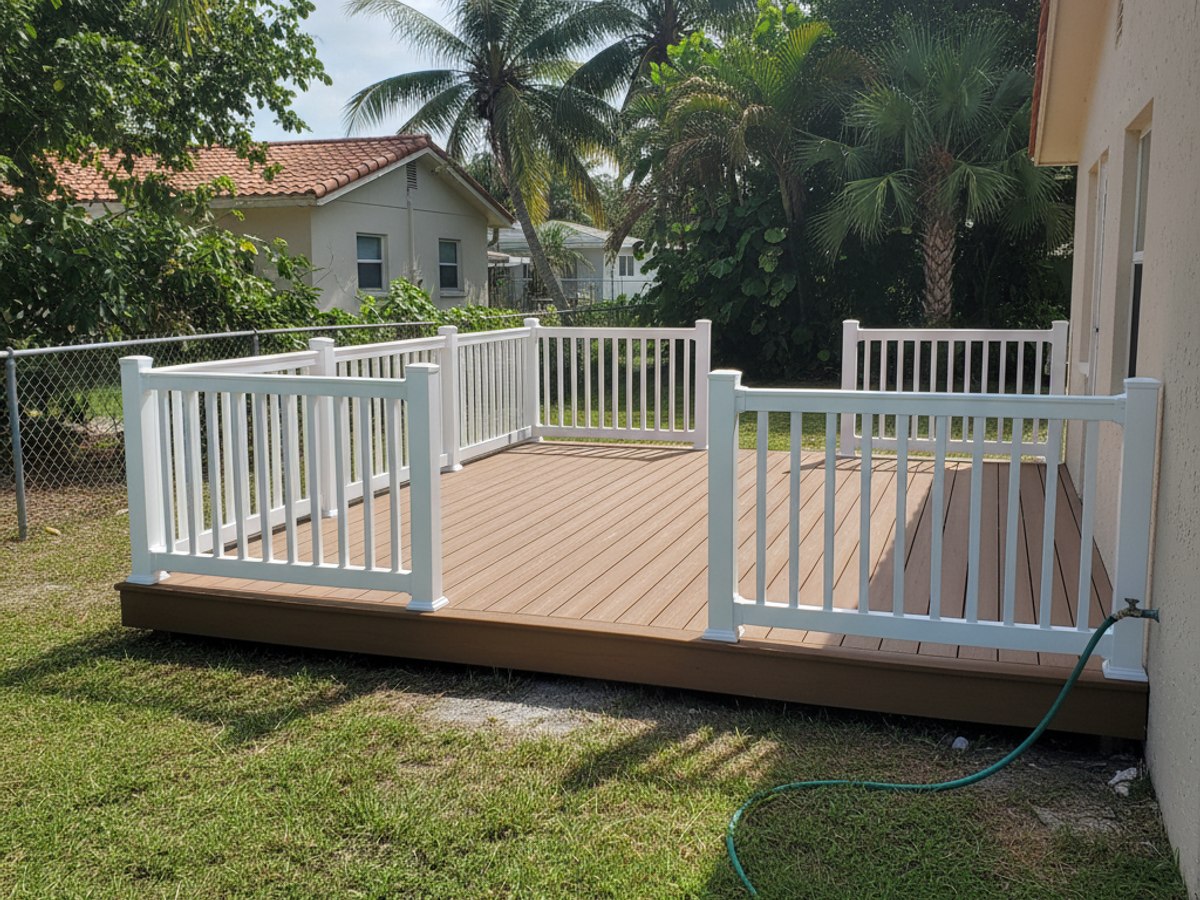
Anybody with a miter saw and a truck can call themselves a deck builder. Central Florida's sandy soil and our building code make some of the mistakes they can make expensive, so it's worth knowing what a real deck job looks like before you sign anything.
Start with the license, not the price
Florida requires a license for structural work like decks attached to a house, and you can look that license number up on the DBPR website in about two minutes. Ask for it before you ask for a quote. A contractor who hesitates or says "I'm bonded through my supplier" isn't licensed the way the state means it. Insurance matters just as much, specifically workers' comp. If a subcontractor falls off a ladder on your property and the crew has no coverage, that liability can land on you.
What our ground actually does to a deck
Most of Davenport and the towns around it, ChampionsGate, Haines City, Poinciana, sit on sandy soil that drains fast and doesn't hold much weight per square foot compared to clay. That means footings here aren't about frost depth, we don't get freeze-thaw cycles that heave concrete the way they do up north. They're about bearing capacity. A footing that's too shallow or too narrow will settle unevenly in loose sand, and an unevenly settled deck shows up as a door that won't shut on the screened porch above it, or a railing post that leans a half inch by year two. Florida Building Code generally calls for footings poured below grade with enough width to spread the load, and on a lot with a high water table, closer to Lake Marion or Lake Davenport, a builder may need to go deeper or use a helical pier instead of a poured footer. Ask how deep the footings will go and why. A builder who's done real work here will have an answer without pausing.
Permits are not optional and not a formality
Depending on where your lot sits, your permit goes through the City of Davenport building department or Polk County if you're outside city limits. Either way, an attached deck typically needs a permit, and the inspector will want to see the footings before they're covered with concrete and the ledger board attachment before the decking goes down. If your builder says permits "slow things down" or offers to skip one to save you money, that's the moment to walk away. An unpermitted deck can become a problem when you sell the house, because it shows up on a survey or gets flagged at closing, and by then it's your name on the title, not theirs. If you're in a newer subdivision like Providence or one of the ChampionsGate communities, add the HOA to that list too. Most of those have design review for anything visible from the street or the golf course, and that approval usually needs to happen before the permit application, not after.
The parts that actually fail
Decks in this climate don't rot from cold, they rot from water sitting where it shouldn't and heat cycling that dries wood out and opens joints for moisture to get in. A few specific things to check when you're comparing bids:
- The ledger board, where the deck bolts to the house, should have flashing behind it to keep water from tracking into the wall framing. This is the single most common failure point on older decks we get called to repair, and it's invisible once the decking's on.
- Joist spacing should be 16 inches on center for most decking, tighter at 12 inches for some composite boards that flex more in heat. Ask what spacing they're using and whether it matches the decking manufacturer's spec, because using the wrong spacing can void a composite warranty.
- Hardware should be rated for exterior use, hot-dip galvanized or stainless, not the bright zinc screws from a box store bin. Florida humidity corrodes the wrong fastener in a couple of years.
- Post-to-beam and beam-to-footing connections need real hardware, not just toe-nailed lumber. This is what keeps a deck attached to its footings in a strong wind event, and it's also one of the cheapest things to skip if a builder is racing through a job.
Wood or composite, and what our summer does to each
Pressure-treated southern yellow pine is still the most common frame material here and it's fine for the structure underneath, but it needs to acclimate for a few days before staining and it will need re-sealing every year or two once our summer sun and rain get at it. Composite decking, Trex and TimberTech being the two you'll see most, costs more up front but doesn't need staining and handles our humidity better. It does expand and contract with heat more than people expect, so gaps between boards need to be set correctly at install or you'll get buckling by the second August. A builder who's installed a lot of composite here will mention this without being asked.
What to walk away from
A contractor who won't put board spacing, joist spacing, footing depth, and fastener type in the written contract is leaving room to cut corners later. A quote that's dramatically lower than the others usually means shallower footings, untreated lumber, or no permit, not a better deal. Be wary of anyone who wants full payment up front, a deposit to cover materials is normal, the balance should follow the work. And ask how long the project will take to get a permit approved and inspected, not just how long the build itself takes. In Polk County that can add a couple of weeks on either end of the actual construction, and a builder who tells you it'll be done in three days start to finish either doesn't know that or isn't planning to pull one.
If you want to see how we handle footings, permitting, and material choice on an actual job, take a look at our deck builder work around Davenport and the surrounding towns.